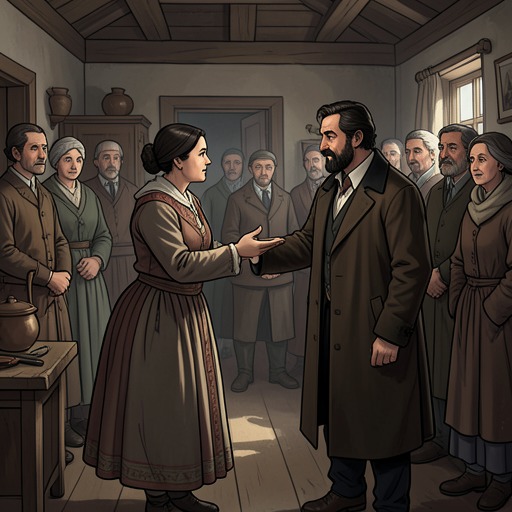
Mary Cavendish and Dr. Bauerstein
The Mysterious Affair at StylesMary Cavendish and Dr. Bauerstein are linked in the household’s suspicions by her continued visits to him and by the gossip that the two have been seen together across the country. Yet the apparent intimacy proves misleading: Poirot judges that Mary has never cared for Bauerstein, and that the doctor has benefited from the rumors rather than reciprocating her affection. Their connection therefore matters less as a love affair than as a false explanation that obscures other relationships and conduct in the murder investigation.
The Public Story and the Private Reality
The association becomes conspicuous through reports that Mary and Bauerstein have wandered about together. Hastings reacts indignantly, treating the reported companionship as evidence of a personal attachment and resenting the possibility that Mary has been involved with the doctor. Poirot offers a less romantic and more calculating interpretation: gossip coupling their names has kept attention fixed on the supposed relationship, so that Bauerstein’s other activities have gone unnoticed. He allows that he cannot know whether the doctor ever cared for Mary, but is certain that Mary herself did not care for him.
That distinction reverses the ordinary meaning of the rumor. What looks to Hastings like a revelation of Mary’s emotional allegiance is, in Poirot’s account, a useful diversion around Bauerstein. The story does not establish that Mary and the doctor were lovers; instead, it makes the appearance of intimacy part of the investigation’s misleading surface. Poirot’s conclusion is explicit, while the evidence supporting it in these scenes is interpretive rather than a narrated confession by Mary.
The Confrontation with John
The relationship’s clearest domestic consequence appears in a scene Hastings overhears after waking from a dream. He finds John and Mary facing one another, apparently unaware that he is nearby. John asks whether Mary intends to continue seeing Bauerstein against his express wishes; Mary replies that she will do so if she chooses. John presses the confrontation with a challenge, and Hastings hears the exchange as a genuine marital quarrel rather than a discussion about the doctor’s medical work alone.
The scene establishes the fact of John’s opposition and Mary’s refusal to accept his control over her decision. It does not explain the full nature or frequency of her visits, nor does it prove romantic feeling. Its dramatic force comes from the gap between the intensity of the argument and Poirot’s later judgment that Mary has never cared for Bauerstein. The affair-like rumor and the marriage’s visible discord converge in one moment, but they are not the same fact: Mary’s defiance is real even when the supposed attachment is not.
Rumor as Cover and Misreading
Hastings’s reaction shows how readily the public association can be mistaken for its meaning. He sees Bauerstein’s reported companionship with Mary and assumes that the doctor may have captured her affections. Poirot instead suggests that Bauerstein found the gossip useful, because it directed attention toward a supposed liaison and away from his other conduct. The rumor consequently operates as cover, whether or not Mary understood its usefulness to him; the cited scenes do not establish her knowledge or intention.
This misdirection belongs to the novel’s larger pattern of appearances that invite premature conclusions. A visible association can attract suspicion without revealing the parties’ actual emotional relation, and indignation at the supposed affair can itself distract from the question of who benefits from the talk. Poirot separates Mary’s marital independence from Hastings’s romantic conjecture and Bauerstein’s apparent closeness from the doctor’s interests. The relation is thus significant chiefly as a misleading social story: it shapes how Mary is judged while giving Bauerstein a shield of gossip.